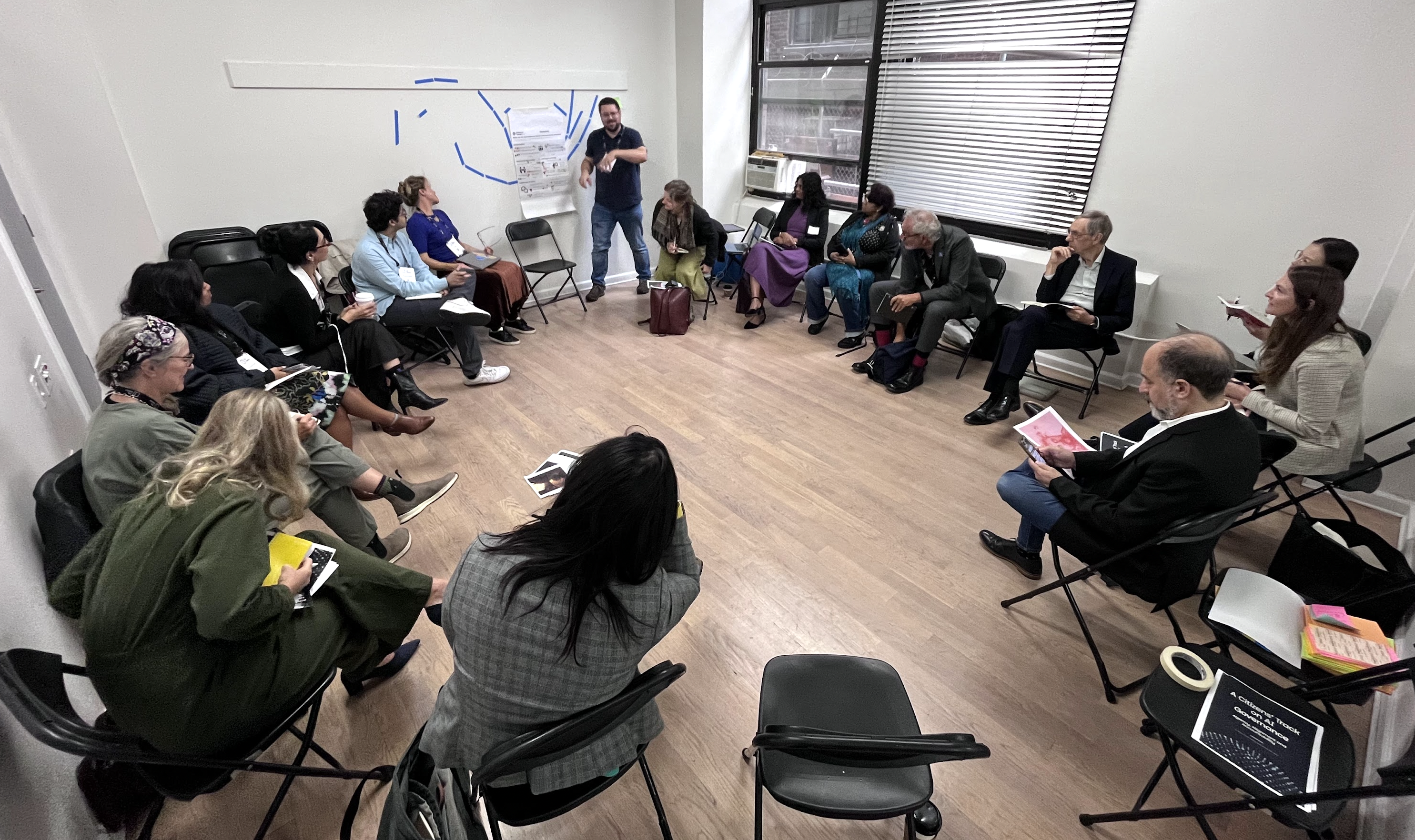
On 21st September we were hosted by The Sidebar for a workshop session to help shape the community assemblies on AI toolkit.
Write-up
The workshop explored themes that could be addressed in a community assembly toolkit, challenges in addressing these themes, and ideas for activities that could help. The session split into three groups, respectively exploring: 101 (Literacy & Values), Democracy & Governance, and Safety & Material Impacts.
1. What Participants Need to Know (Core Concepts)
- Embedded Values & Philosophies: AI is not neutral. Dominant models reflect specific ideologies of their creators—notably Effective Altruism, Transhumanism, and Long-Termism—which define human flourishing and intelligence in narrow ways.
- The Illusion of Personhood: Humans naturally anthropomorphize conversational agents. Using the pronoun “I” (Sherry Turkle’s framing of AI’s “original sin”) deceives users into treating pattern recognition as consciousness, creating serious emotional risks for vulnerable, depressed, or isolated individuals.
- Defaults and Hidden Agency: Users routinely accept defaults without realizing they can instruct models (e.g., demanding neutral tone, refusing obsequious flattery) or choose non-dominant, specialized, or community-led open-source models.
- Vulnerabilities of Democracy: How commercial AI undermines the pillars of civic life—eroding deliberation, offloading critical thought, accelerating disinformation, and replacing public interest with private incentive structures.
- Two-Track Safety Realities:
- Immediate/Everyday Safety: Mental health dependency, non-consensual imagery (NCII/CSAM), cognitive erosion, and workplace displacement.
- Frontier/Systemic Safety: Existential risks, weaponization, geopolitics (US–China bilateral safety paths), and resource extraction (grid, water, and noise pollution from local data centers).
2. Learning & Discussion Activities
- “Who Made This?” Ideology Audit: Move away from abstract tech jargon by examining key figures (Edison vs. Musk, Zuckerberg, Grace Hopper, Marie Curie) to ask: What were their financial and social values, and how are those embedded in the tool?
- “Creepy / Uncanny Moments” Sharing Circle: Participants share the first time an AI tool felt unsettling or overly personal (e.g., an LLM tracking fatigue or using their name unprompted) to demystify pattern matching vs. genuine empathy.
- Settings & Prompt Literacy Demos: A hands-on exercise opening the configuration screen to show how to alter system prompts, opt out of training data, and strip sycophantic behavior.
- “Ingredients Label” & Cost Inspection: Trace a single prompt back to who profits per token, the underlying compute cost, and its environmental draw (framing usage in monetary terms rather than abstract carbon metrics).
- Democratic Levers Analysis: Examine historical precedents (e.g., social media regulatory failures) alongside active international case studies (e.g., Kenya’s use of AI alerts for civic mobilization vs. state demobilization tactics).
3. Emergent Community Actions & Democratic Demands
- Contract Procurement & Cancellation Levers: Pressure municipal governments to audit, restrict, or outright cancel public contracts with opaque frontier AI vendors.
- Data Center Siting & Environmental Justice Coalitions: Mobilize local resistance and zoning demands targeting water use, energy grid strain, and community health impacts.
- Community-Led & Open-Source AI: Support and deploy open models governed by impacted communities rather than developer consortia.
- “Point-of-Use” Safety Guardrails: Establish contextual boundaries and civic guidelines (similar to safety rules at ski resorts or public pools) for when to disengage from AI and turn to human support networks.
4. Deliberation Synthesis Matrix
| Focus Area | Core Deliberative Friction | Grounding Analogy / Activity | Desired Civic Outcome |
|---|---|---|---|
| AI 101 | Inevitability & false personhood | Talk about adoption of calculators; sharing “uncanny/creepy” moments | Developing community “folk wisdom”; mastering settings & prompts |
| Democracy | Frontier corporate capture vs. slow public governance | Social media regulation failures vs. Kenyan civic mobilizations | Identifying state levers (e.g., public procurement cancellations) |
| Safety | Speculative existential risk vs. urgent local harms | “Ingredients label” / seeing the AI in use inside a building | Engaging with data center resistance; establishing open, community-led models |
AI Disclosure statement
The text above was generated using LLM summarisation based on manually transcribed post-it notes written by session participant: AIA Primarily human, Content edits, Human-initiated, Reviewed, Gemini 3.8 Flash v1.0.
The raw post-it notes have separately been included in a manual cross-workshop comparison of themes.
Original invite
AI governance is becoming a global priority. But as governments, companies, and international institutions debate the rules that should shape AI, a fundamental question remains: how do ordinary people get a meaningful say in decisions that will affect their lives?
Around the world, communities are already experimenting with ways to involve the public in conversations about AI. The Citizens’ Track on AI has mapped more than 80 public engagement initiatives globally and is working to connect grassroots dialogue with international processes such as the UN Global Dialogue on AI Governance (UNGDAI).
The challenge is not simply getting more people into the conversation.
Public participation only matters if there is a credible pathway between what communities say and where decisions are actually made. How should a conversation in a neighborhood, city, or community connect to national policy or global governance? How do we ensure participation reaches beyond the people who already understand AI policy? What makes a dialogue meaningful rather than extractive? And what would make policymakers take its findings seriously?
The Citizens’ Track on AI is now developing a practical toolkit to help communities around the world convene their own dialogues on the future of AI. This Sidebar session will become part of that design process.
Participants will help explore what communities need to have useful conversations about AI, how those conversations should be structured, whose voices are most important to include, and how insights generated locally can travel upward into institutions and global decision-making.
The ambition is to make public participation in AI governance something that can happen across many different communities and contexts, without losing the connection between grassroots voice and global power.
What to expect
A participatory working session beginning with a small number of short provocations from people working on public participation, AI governance, and citizens’ assemblies before moving quickly into small-group work.
Participants will tackle two practical challenges: how do we support meaningful grassroots conversations about AI, and how do we make those conversations matter to global decision-makers?
Groups will draw on their own experience to identify what a useful community dialogue toolkit should contain, where existing participation models succeed or fail, and what partnerships could connect local conversations to wider governance processes.
The session will close by bringing those ideas together and identifying potential collaborators for the next stage of the Citizens’ Track on AI.
Who this is for
This session is for civil society organizations, governments, AI governance practitioners, public participation experts, community organizers, researchers, funders, technology companies, and others interested in ensuring that decisions about AI are shaped by a much wider range of people than those currently inside the institutions making them.
What you will get out of it
- A clearer understanding of how public participation can contribute to AI governance
- Lessons from existing public engagement initiatives around the world
- A chance to shape a practical toolkit for grassroots community dialogue on AI
- Practical thinking about how community-generated perspectives can influence national and global decision-making
- Connections with potential partners working to strengthen public voice in the future of AI
Hosted by
The Citizens’ Track on AI at The Sidebar.