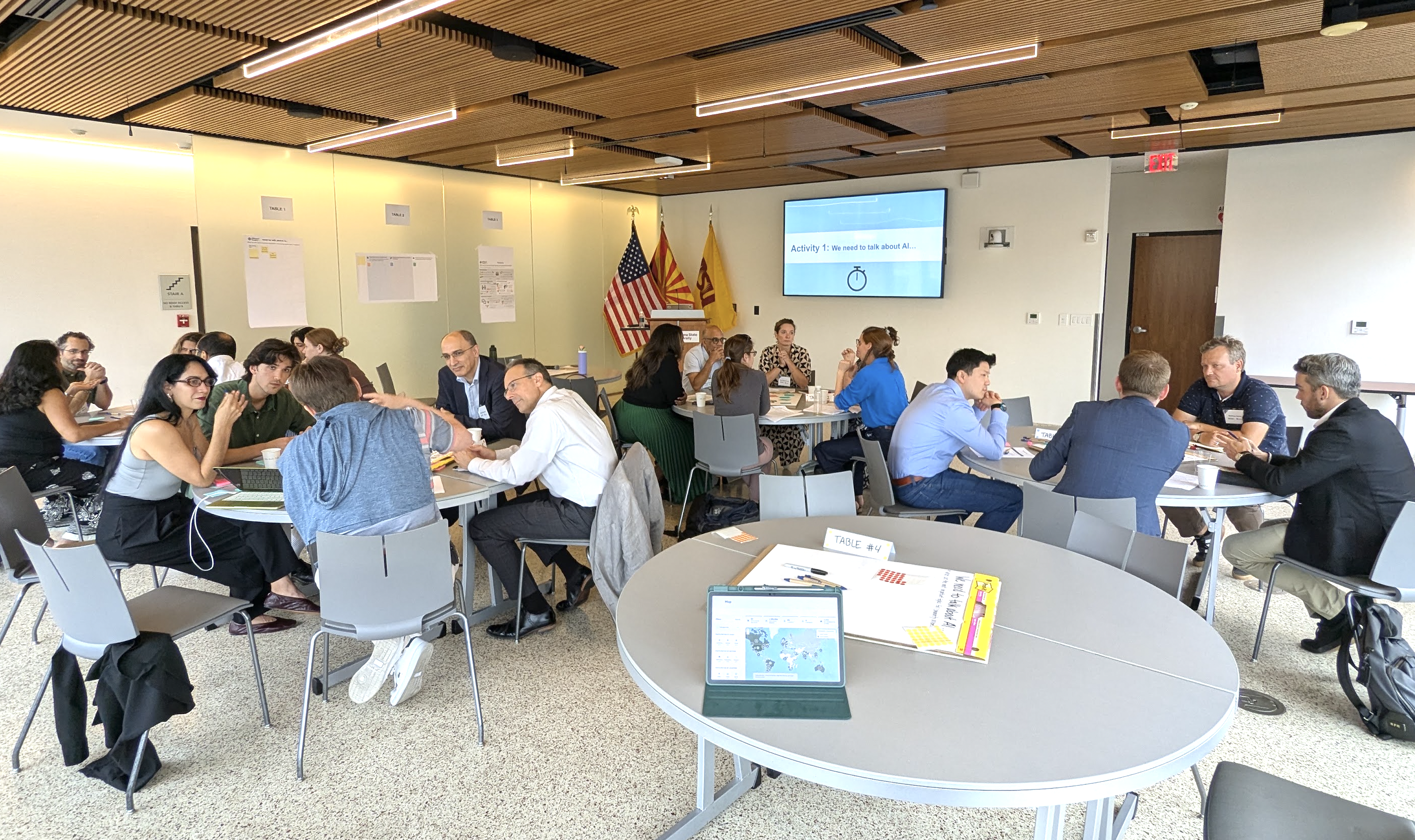
On 18th September the Consortium for Science, Policy and Outcomes of Arizona State University hosted the Citizens’ Track on AI for a workshop on priorities for the community assemblies on AI toolkit.
Write up
The following summary highlights a number of the themes exploring during the session, organized around key design questions and reflecting themes captured across the tables, which took deep-dives respectively into AI 101 & Foundations, Safety, Governance & Rights, and Environment & Infrastructure.
1. What Background Knowledge & Concepts Do Participants Need to Know?
- AI Beyond LLMs: Distinguish generative text tools (LLMs) from predictive, analytical, and automated physical systems (robotics, self-driving cars, automated agriculture, delivery bots, public-service algorithms).
- The Political Economy of Data: How data power imbalances form (anti-trust, monopolies, data silos); the business model of AI firms (revenue, data harvesting) vs. traditional internet companies; and IP/ownership questions around co-created work.
- Governance Landscape: The lack of global oversight; how regulatory power rests primarily at national/local levels; what legal protections and avenues for technological due process exist today.
- Environmental Materiality: The tangible footprint of computation—how much water and energy data centers consume, what water “use” means locally, and the physical siting choices behind infrastructure.
- Societal & Psycho-Social Risks: Reproduction of systemic bias (particularly in low-resource languages); labor disruption; impacts on children using conversational agents; and epistemic instability (“What is real anymore?”).
2. What Learning & Discussion Activities Could Help?
- Media Story Deconstruction: Dissect popular news coverage—identify who is quoted, whose interests are behind the framing, and how narratives shape public panic or hype.
- Fishbowl & Multi-Stakeholder Dialogues: Moderated conversations between community members, technical experts, and local policymakers to demystify decision-making and break down technical jargon (“Nobody knows nothing; nobody knows everything”).
- Output Variance Demos: Hands-on comparisons of live model outputs to demonstrate hallucination, bias, and variability across queries.
- Mapping Exercises:
- Circle of Concern vs. Circle of Control: Sort issues into what participants can directly influence versus systemic conditions.
-
Individual Control vs. Collective Action Axis: Plot personal hopes, fears, and security habits against actions requiring civic organizing.
- Constructive Facilitation Protocols: Acknowledge pre-existing institutional distrust directly rather than dismissing skepticism or conspiracy theories; center lived experiences over abstract hypotheticals.
3. What Community Actions & Policy Outcomes Could Emerge?
- Public Procurement Standards: Demand binding community oversight, auditing, and transparency conditions before local governments or school districts purchase AI software.
- Citizen Rights to Infrastructure Transparency: Require open reporting on data center resource consumption (water draw, grid capacity) and zoning approval conditions.
- Local Redress & Feedback Mechanisms: Create clear, non-automated pathways to register complaints, demand technological due process, and contest algorithmic public-service decisions.
- Grassroots Mobilization: Petitions, public documentation of automated harms, and coordinated civic feedback directly to municipal councils.
- Lifelong Education & Safety Support: Establish community-run digital hygiene workshops, youth safety guidelines, and local workforce retraining initiatives.
4. Fascilitation challenges
Across the discussions, we identified a number of facilitation challenges. A selection of these are summarised below:
| Theme | Core Focus | Key Deliberative Risk | Potential activities |
|---|---|---|---|
| AI 101 | Everyday, invisible AI systems | Getting trapped solely in ChatGPT hype | Output variance comparison & media deconstruction |
| Safety & Rights | Due process, liability, child wellbeing | Cynicism and feelings of powerlessness | Mapping concerns onto the Collective Action axis |
| Environment | Data center power and water loads | Abstracting global climate stats from local realities | Auditing local utility impacts and municipal siting plans |
| Governance | Institutional procurement & accountability | Confusing national/global authority | Drafting public procurement criteria for town councils |
AI Disclosure statement
The text above was generated using LLM summarisation based on manually transcribed post-it notes written by session participant: AIA Primarily human, Content edits, Human-initiated, Reviewed, Gemini 3.8 Flash v1.0.
The raw post-it notes have separately been included in a manual cross-workshop comparison of themes.
Original event invite
The impacts of AI, and the wider forces around it, are arriving fast. But what happens when communities have time to pause, learn about, share different perspectives on, and discuss AI?
The Citizens’ Track on AI governance is an initiative to foster grassroots public participation around AI, and to connect grassroots views with the spaces that are shaping the future of AI, from communities, to industry and global governance fora.
Over October we’re planning to co-create a toolkit for ‘community assemblies on AI’: independently organised gatherings that invite participants to take part in flexible learning and discussion activities, looking at AI from different angles, before identifying messages and actions they want taken forward.
Join this workshop to learn more about the Citizens’ Track, how community assemblies can transform public engagement around AI, and to shape the priorities for our upcoming co-creation sprint.
Hosted by the Consortium for Science, Policy and Outcomes of Arizona State University, and drawing on insights from Participatory Technology Assessment (PTA) work and the Public AI Voice and Engagement Case Book this will be a hands-on session, followed by a short networking reception.