On 17th September, we ran a workshop at community theatre space, Gray Area, in the Mission District of San Francisco to explore priorities and precedents for a Community Assemblies on AI Toolkit.
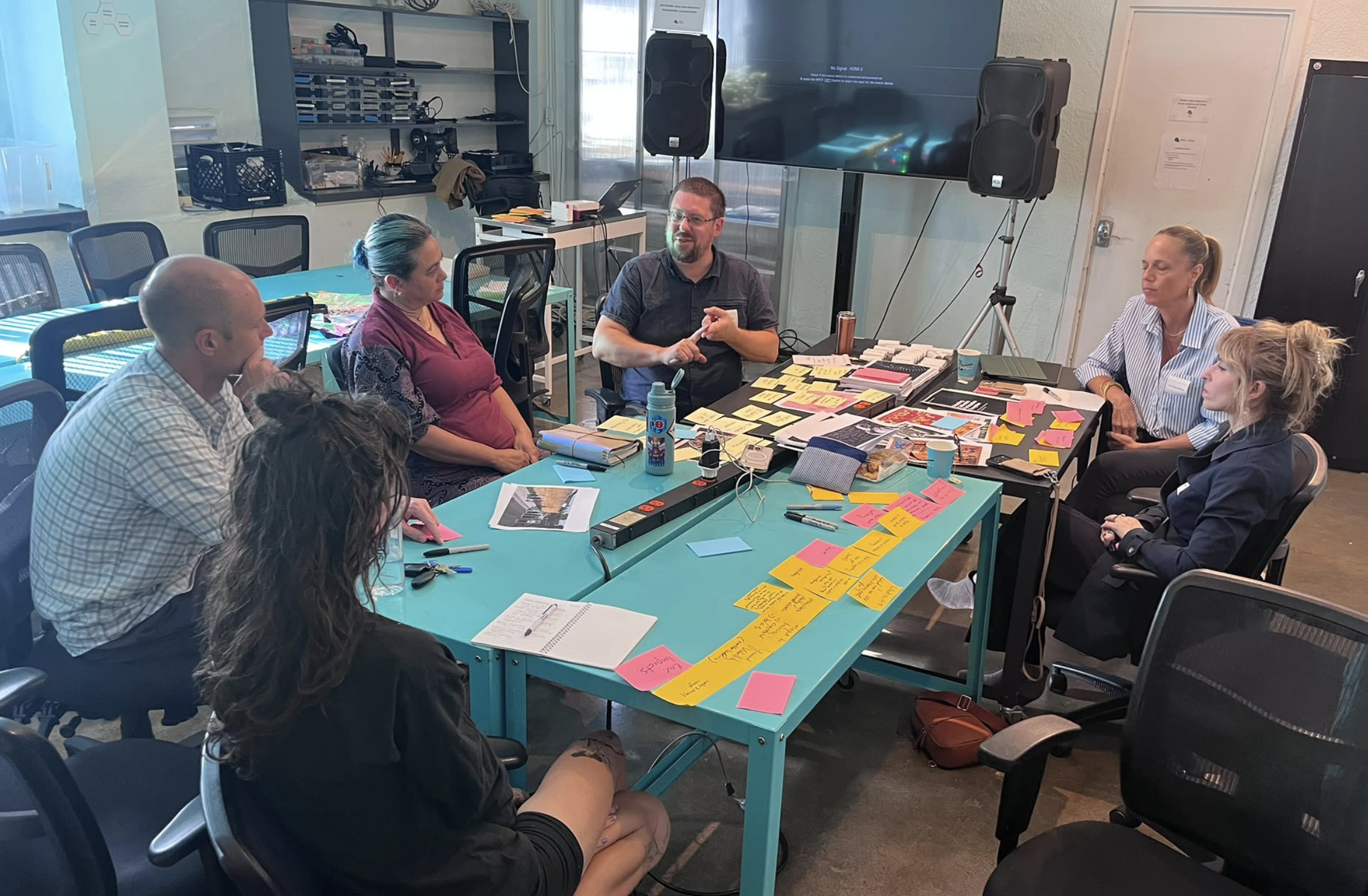
Workshop notes
In addition to adding a range of suggested resources to our resource library, the session surfaced a number of potential themes to address in community dialogue:
1. Labor, Livelihoods & the Workplace
- Job displacement & impact: Concerns regarding workforce transitions, job loss, and remaining economically relevant (“How can I not get left behind?”).
- Worker compensation & equity: Fair pay, shifting worker conditions, and financial lock-in.
2. Mental Health, Relationships & Social Isolation
- Companionship & bots: Emotional reliance on AI chatbots, synthetic relationships, and their role in personal isolation.
- Wellbeing: General impacts on community and individual mental health.
3. Youth, Education & Child Safety
- Learning environments: Classroom integration, pedagogical shifts, and curriculum adaptations.
- Youth norms & safety: Direct risks, safeguards, benefits, and developmental norms for children using AI.
4. Surveillance, Privacy & Urban Protection
- Urban AI & civic safety: Drone surveillance, physical monitoring, and community defense mechanisms.
- Data governance: Corporate tracking, private data collection, and long-term surveillance harms.
5. Democracy, Power & Authoritarian Control
- Political power: Corporate concentration of leverage, geopolitical authoritarianism, and systemic control.
- Democratic utility: Using AI tools constructively to support democratic processes versus AI subverting them.
6. Environmental Footprint & Infrastructure
- Physical footprint: Severe resource draw of data centers, including electricity consumption, grid strain, and water use for cooling.
7. Culture, Identity & Digital Sovereignty
- Local expression: AI’s effect on creativity, art, and localized culture.
- Linguistic accessibility: Multilingual support and preventing language marginalization.
- Data sovereignty: Community rights, attribution, and governance over training datasets, user prompts, and generative outputs.
8. Existential Risk, Public Agency & Governance
- Existential threat: Superintelligence and catastrophic survival risks (“Will AI kill us all?”).
- Public consent & boundary-setting: Determining acceptable boundaries (“What are we ok with?”), feasibility of regulation or halts (“Can it be stopped?”), and rapid reactions to breaking media cycles.
Disclosure statement
The text above was generated using LLM summarisation based on manually transcribed post-it notes written by session participant: AIA Primarily human, Content edits, Human-initiated, Reviewed, Gemini 3.8 Flash v1.0.
The raw post-it notes have separately been included in a manual cross-workshop comparison of themes.
Original invite
Who gets to shape the conversation about artificial intelligence?
How can we hold space for open community dialogues to explore different perspectives on AI?
What questions, inputs and actions could and should community assemblies on AI explore?
As part of the global Citizens Track on AI project, we’re co-designing a toolkit for informed, active conversations that let communities explore and share views on the future of, or a future alongside, AI.
Join us for a two hour workshop to:
-
Learn about the Citizens’ Track on AI: putting people in the lead
-
Suggest priority questions for Community Assemblies to address
-
Explore the key knowledge that people need to have meaningful discussions on AI - and and perspectives its important to be aware of
-
Discuss approaches for community dialogue and action
Who is this for?
Join us if you are interested in:
-
Critical AI literacy
-
Participation and public engagement
-
Arts, cultural and community action responses to AI
-
Public voice in local and global AI policy making
This will be an interactive workshop. Participants should agree to abide by our code of conduct.
Who are we?
The Citizens Track on AI is an initiative to embed public voice in the governance of data and AI at all levels.
We created the PAVE Case Book to map existing examples of public engagement on AI across the world.
Now we’re working to create a resource that can support many more grassroots communities to get together, deliberate, and share ideas and actions for shaping AI in the public interest.